Curriculum Development Series (Part 2)
Starting with an Inclusive Lens
This is part two of my Curriculum Development series. While Part 1 set out what we are doing and why, this piece starts to explore some of my research and initial ideas, focusing specifically on how we make a curriculum truly inclusive.
This is the research phase, a journey of reading, discussing, visiting, and generally mulling over what I think and feel. At this stage, I am intentionally avoiding AI in search of a deeper, more genuine pathway of discovery. In some recent training with Sofia Fenichell, she made an obvious point about AI that had completely passed me by (I am paraphrasing here, as I didn’t write it down verbatim):
AI is simply telling you what is already known. It is a large language model taking information that already exists. It can tell you things you were not aware of, but it is not coming up with something novel. To generate something truly novel, we need time, research, and investment in new ideas.
I am not necessarily seeking to reinvent the wheel, but I want to know that the decisions I make about the curriculum in my school are born of brainpower, deep thought, dead ends, human collaboration, discovery, and dismissed ideas. I don’t want a shortcut.
So, I started with a book: SEND Huh! by Mary Myatt and John Tomsett.
Context
It is important to explain here that we are not an ordinary school! Our context is complex, with a clearly defined structure of Universal, Targeted, and Specialist provision. We are a truly inclusive, non-selective school catering for learners from age two to 25. While we have several distinct parts, we share one site, one clear vision, and one purpose. There is deep collaboration across each section; we really are one school.
Universal
We start quite traditionally with a nursery and a junior school up to the end of Year 6, with our senior school starting in Year 7. Most of our students sit within our Universal offer (we aren’t entirely comfortable with the language of 'mainstream'). This follows a traditional vision of education with tutor time and five lessons a day across a broad and balanced curriculum.
Targeted
Alongside our Universal offer sits BRIDGE—a nurturing, supportive environment that complements the Universal offer. All students in BRIDGE have an EHCP or are awaiting one. They access the Universal curriculum but receive targeted support, and their tutor time can be hosted within BRIDGE.
Students in BRIDGE automatically access our Learning and Development Centre three times a week, giving them access to a Dyslexia tutor, Literacy tutor, Emotional Literacy Support Assistant (ELSA), and a Speech and Language therapist. Any teacher under allocation will have sessions in the Centre, teaching study skills or offering tutoring to students who may not be able to access standard lessons due to EBSA/EBSNA or other barriers.
Additionally, we have a Private Study space staffed by a qualified teacher. This is for students operating on a reduced timetable who don't need direct interventions but require more time to complete homework or space to regulate.
Specialist
We are proud to have our own specialised unit (rebrand pending) for students with Autism and an EHCP, many of whom access elements of the Universal curriculum. Many of these students have experienced gaps in their education due to previous school placements not working out. We offer a calm, nurturing environment where they can rebuild their sense of self, belonging, and trust in an educational setting.
Some students spend their entire time in the unit, following a full curriculum that mirrors their peers but in much smaller classes. Others gradually take on more Universal lessons—for example, in Maths, English, or high-interest areas. Our goal is entirely bespoke to each child. There is no expectation that accessing the Universal curriculum is the 'pinnacle of success'; instead, it is about making it available and possible if it suits the child’s needs and ambitions.
What Matters to a Successful Curriculum?
This is my first time working in such an inherently inclusive school, and it has opened my eyes to curriculum considerations far beyond what I had ever imagined. In my previous schools, curriculum discussions focused strictly on what students were taught and the order they were taught it, all to ensure they achieved GCSEs and A-Levels. There was a co-curriculum of enrichment running alongside this (clubs, activities, DofE), but these were schools of clear, linear flight paths—much like the education I received myself as a child.
Working within the SEN sector opens your eyes to what a curriculum can, and should, be to allow all students to thrive. I hope you are familiar by now with the saying, "What is effective for a student with SEN is effective for all students." Previously, my understanding of this was reserved for classroom practice. However, as I started to think more deeply about what a school fundamentally is, this concept became the underpinning of my curriculum research.
The wonder of the Huh! books is that they capture so many different perspectives on the same broad area. One of the things that continues to baffle and amaze me is how, on paper, our ambitions for education should be the same from school to school—and yet we all approach it so differently!
This notion liberates me. If there were a single panacea for education, surely we would all be doing the exact same thing? The closest we get is the MAT model, but even then, each school retains its own unique identity due to its context, locality, teaching specialisms, leadership, and inherent value system.
Due to our context, we already offer a lot of alternative qualifications and pathways to meet the diverse abilities of our students. However, one thing I feel confident about at the beginning of this journey is that qualifications do not a curriculum make.
Thoughts So Far
Only a few chapters into SEND Huh!, my book was already filled with Post-it Notes (my preferred way of processing interesting ideas).
A few concepts are starting to settle into something more concrete.
1. Curriculum is Beyond the Content
The interview with Anita Devi, 'Curriculum content, pedagogy and child development', really set my brain whirring.
She did not lay it out exactly like this, but to me, her insights broke the curriculum down into distinct pillars. When combined with her assertion that we should train teachers on the four broad areas of SEN—rather than focusing narrowly on specific diagnoses like ASC, ADHD, or dyslexia—a model started to form in my mind.
I have always known that the curriculum is more than just content or the arbitrary distinction between lessons and co-curricular activities, but I am starting to see what more it can be:
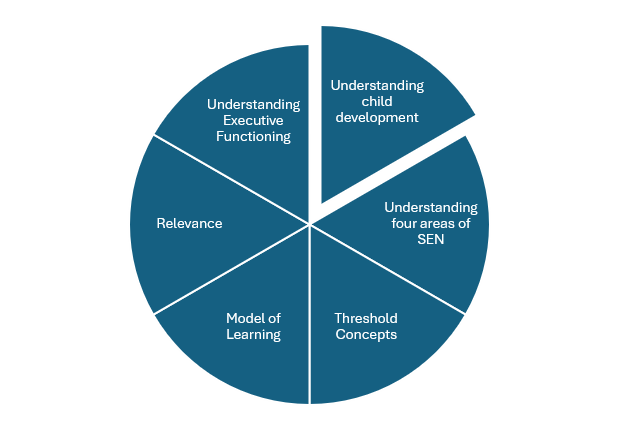
Model of Learning: By this (borrowing Anita Devi’s concept), I mean: what do we believe is important to ensure that learning is actually happening? It’s about the transfer of knowledge and understanding, not just the fact that teaching is taking place. Can we lift a model of learning from somewhere else? Is there a 'best' model we can adopt? Luckily, before I even started this research, my wonderful new Teaching and Learning team had already been tasked with defining our model of learning to improve our Learning Walks... more on that in a future post!
Threshold Concepts: These go beyond the content to look at what specifically acts as a gateway to understanding new information in a subject. Without teachers and Heads of Department having a full grasp of these threshold concepts, how can a curriculum truly succeed?
Relevance: I will never forget the Festival of Education in 2014. Fresh-faced, bushy-tailed, and not even in my teacher training yet, I sat listening to Hywel Roberts talk about his book Oops!, which is all about getting students to learn accidentally—'sticky learning', as I describe it to my teachers now. How can we expect students to grasp abstract, tricky, and important threshold concepts unless they understand why and how it is relevant to them?
Understanding Child Development, Executive Functioning, and the Four Areas of SEN: Knowledge is power. If our teachers have a solid, secure understanding of how students develop and learn—alongside the practical adaptations they can make to ease the journey—it becomes significantly easier to adjust, predict, and understand the complex mix of young people in front of them.
This feels like a neat step forward in my thinking... perhaps too neat! There is no explicit discussion here of enrichment or the world beyond the classroom, though perhaps it is implicit within these sections. Either way, my thinking is settling. We are a long way from a finalised curriculum, but a step closer to understanding what a curriculum, in its broadest sense, might mean.
Executing this also feels manageable. I have broken it down into three key actions (assuming my next bit of research doesn’t derail me!):
Create a coherent, simple model of learning that suits our unique setting while drawing on the latest educational research.
Organise high-quality, recurring training for staff on Child Development, Executive Functioning, and the four areas of SEN.
Start conversations with Heads of Department about Threshold Concepts and relevance. Are they already thinking about this? Who is writing about threshold concepts in their specific subject areas? How do they know their curriculum is relevant to our cohort?
What’s Next?
I have already started work on the first point. I fundamentally believe that a coherent model of learning is our priority. We know we need to elevate the quality of our learning walks and feedback cycles, and we want to underpin this with a clear framework and shared language. Watch this space for updates!
We also have several inclusive learning pedagogy sessions scheduled for this coming academic year. I am going to review these with a critical lens to see if we should shift the focus, centering the start of the year on the four broad areas of need. We can dive into specific diagnoses later, once everyone has a grounded understanding of what each area of need means for day-to-day learning.
The final point on threshold concepts will wait. I need to reflect a little more before opening that particular can of worms with my Heads of Department. Change fatigue is real, and I want to be entirely deliberate and certain before introducing a new layer of thinking to the team.


Comments